
In research-driven innovation, data is often treated as the final destination. Dashboards are built, reports are circulated, and metrics are tracked with increasing sophistication. The prevailing assumption is that more data will naturally reduce uncertainty.
However, research across product development, design research, and innovation management consistently shows that data alone does not reduce risk. What determines success or failure is what organizations do after data is collected.
Many organizations have access to extensive datasets and analytical tools, yet still make costly strategic errors. These failures rarely stem from a lack of information. Instead, they occur when early signals are misinterpreted, decision-making is delayed, or validation happens too late in the innovation process.
Why Data Alone Is Not Enough
Studies in evidence-based management and design thinking reveal a recurring pattern: organizations do not fail because they lack data, but because they struggle to use it effectively. Early insights are often dismissed as anecdotal, while teams wait for more comprehensive evidence before acting. In other cases, data is interpreted in ways that reinforce existing assumptions rather than challenge them.
When raw data is separated from context and analysis, it can create a false sense of certainty. Instead of reducing uncertainty, it masks underlying risks that only surface after significant resources have been committed.
From Data to Meaning: The Role of Early Validation
Early validation changes the role of research from confirmation to learning. At this stage, the objective is not statistical certainty but understanding. Qualitative methods such as user interviews, pilot testing, and early prototypes are particularly effective because they reveal motivations, behaviors, and friction points that large-scale quantitative studies often uncover much later.
Meaning emerges when teams actively interpret what the data is indicating. Repeated patterns across interviews, consistent behaviors during pilot tests, and contradictions between expectations and observed outcomes all point to deeper insights. Asking the right questions becomes critical: What assumptions are being tested? What patterns are recurring? What evidence challenges the original idea?
This interpretive process transforms data into insight.
From Meaning to Action: Where Risk Is Reduced
Insight alone does not reduce uncertainty. Action does.
Research on iterative development and lean innovation models shows that teams that act on insights early consistently outperform those who delay decisions. Acting early may involve refining product direction, adjusting value propositions, reallocating resources, or discontinuing ideas that evidence suggests are weak.
While early action does not guarantee success, it significantly reduces avoidable failure. It allows organizations to learn when change is still feasible and affordable.
The Cost of Skipping Early Validation
When validation is postponed, incorrect assumptions compound over time. By the time issues become visible, organizations have often invested substantial time, capital, and credibility. Innovation studies consistently show that late-stage pivots are more expensive and disruptive than early course corrections.
Early validation minimizes this risk by surfacing problems before they scale.
What the Evidence Makes Clear
Early validation is not about proving an idea is right. It is about discovering where it is wrong early enough to respond effectively.
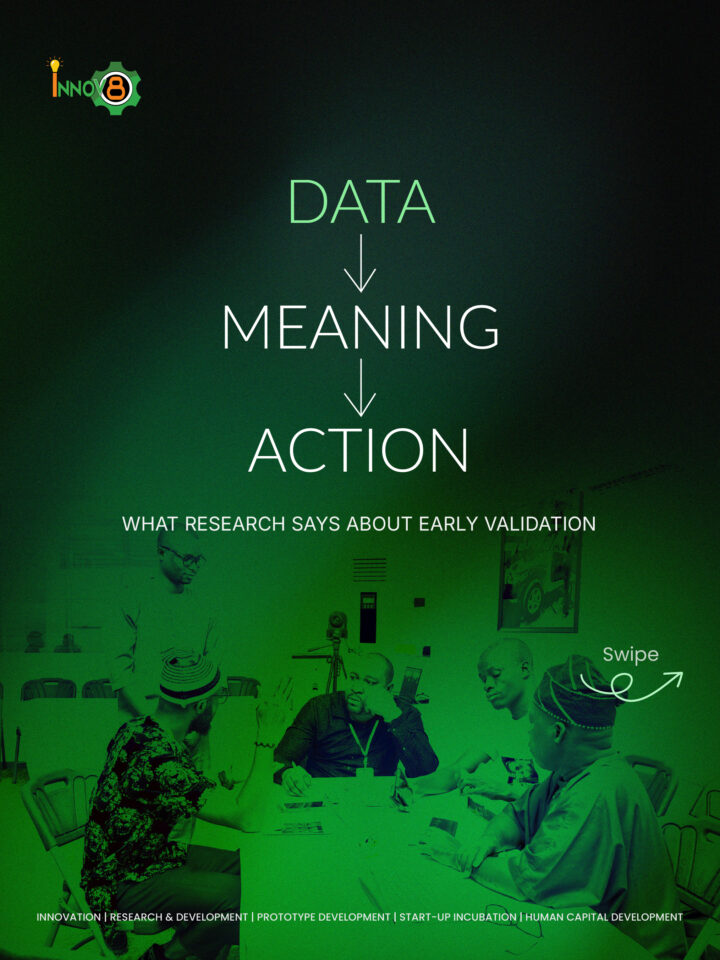
Data becomes valuable only when it follows a deliberate progression: Data → Meaning → Action. Organizations that embrace this approach do not simply collect insights. They use them to make informed, timely decisions that reduce risk and improve long-term outcomes.