While the world watches fintech unicorns grab headlines, in Nigeria, a different kind of revolution is taking place: one farmer, one patient, one student at a time.
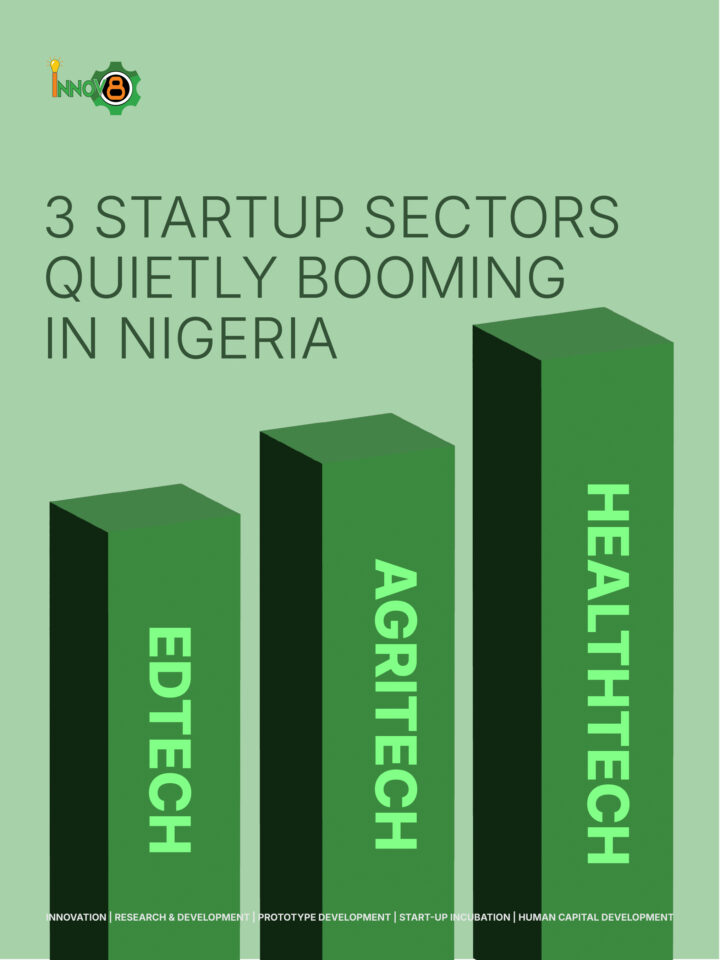
Scaling in Nigeria is difficult. It is also, by nearly every available metric, one of the most fertile environments for startup innovation on the planet. Nigeria is home to more than 24,000 registered startups, has produced at least three unicorns, and has attracted billions in venture capital over the past decade. Fintech, the sector that put Nigerian tech on the global map, still dominates the funding conversation. But beneath that dominant narrative, three other sectors are experiencing a quieter, more structurally significant boom: agritech, healthtech, and edtech.
These are sectors solving problems so fundamental, so embedded in the daily texture of Nigerian life, that their growth feels less like disruption and more like long-overdue repair.
AgriTech
Nigeria feeds a nation of more than 220 million people, yet agriculture has long been one of its most technologically underserved sectors. Farmers with no access to credit, no reliable market data, and no way to manage input costs have, for decades, been operating largely on instinct and inheritance.
That is beginning to change. In agriculture, smart technologies like sensors and drone monitoring are changing the game for farmers, while the Nigerian government, in partnership with the Food and Agriculture Organization (FAO), launched the Digital Village Initiative in May 2025 to promote digitalization across the agricultural sector. Startups are stepping into the gaps that state infrastructure has never filled by connecting smallholder farmers to financing, digital marketplaces, and supply chain tools that were previously available only to large commercial operations.
Agritech startups are helping farmers access finance, storage, logistics, and digital marketplaces, with some agritech models attracting more funding because of their sustainability focus. Food security and smart farming remain key trends in Nigerian startups.
The investment community has taken notice. Agritech startup Basket secured $300,000 in April 2026, signaling that agritech remains relevant, especially in solving food supply chain inefficiencies. It is a modest sum by Silicon Valley standards, but in a sector where the median farmer operates on thin margins and thinner trust, capital of any size sends a signal.
What makes Nigeria’s agritech moment particularly significant is not just the funding. It is the structural logic. Nigeria’s agricultural sector contributes roughly a quarter of GDP and employs the majority of the rural population. Every efficiency gained at the farm level ripples outward. When a farmer in Benue State gets real-time soil moisture data on a mobile phone, or a cooperative in Ogun State connects directly to a Lagos food distributor through a digital platform, entire value chains reorganize around that moment of connection.
Companies like Thrive Agric are also using technology to improve agriculture and food production, with these advancements helping to increase productivity and sustainability in the agricultural sector.
The critics, and there are always critics, will say that Nigerian agritech has had false dawns before. Startups have launched with great fanfare and collapsed under the weight of last-mile logistics failures, unreliable power, and farmers who, understandably, are slow to trust platforms built by people who have never planted anything. The founders who are succeeding in 2026 are the ones who understood that problem early. They moved to the farms. They hired from the communities they serve. They built trust before they built the technology.
HealthTech
The statistics are stark enough to be almost abstract. Per Punch Newspaper, Nigeria has one doctor for roughly every 9,000 citizens, a ratio worsened by what is locally termed the “japa wave,” a steady migration of medical practitioners who seek better pay and conditions abroad. As a result, hospitals in rural areas are frequently understocked, underequipped, and overwhelmed. For tens of millions of Nigerians, getting sick is not just a medical event; it is a logistical and financial crisis.
Healthtech startups have identified that gap and are building inside it with a speed and specificity that traditional healthcare infrastructure cannot match.
Healthcare startups are solving supply chain problems, improving access to medicine, and digitizing patient services. Some health startups are already growing fast by helping pharmacies and hospitals manage supply and logistics digitally. Healthcare access remains a major need, making this one of the strongest Nigerian startup trends.
The investment picture reflects growing confidence. Healthcare startup Biovana raised $200,000, highlighting ongoing but cautious investor interest in health innovation. Meanwhile, the broader landscape shows consistent deal flow: March 2026 included Biovana’s $300,000 healthcare pre-seed deal, and April 2026 recorded deals across fintech, healthcare, agriculture, and sustainability sectors, with investor participation from venture capital firms, angel investors, impact-focused organizations, and strategic acquirers.
What distinguishes the healthtech companies gaining real traction is their refusal to simply transplant Western telemedicine models onto Nigerian infrastructure. The startups that are working are the ones that have reckoned honestly with the country’s digital divide, building platforms that function on low-bandwidth connections, that operate in local languages, and that integrate with community health workers rather than trying to replace them.
Across the health tech landscape, companies like Intron Health, with speech and clinical documentation technology tailored to African languages, raised notable funding in 2025, underlining investor confidence in scalable digital health tools.
There is a deeper shift underway, too. Nigerian health tech is beginning to produce founders who are not just building startups but building institutional knowledge, training datasets, diagnostic tools, and clinical workflows that are specific to the disease profiles and demographic realities of West African populations. That specificity, which once looked like a limitation, is increasingly the thing that makes these companies valuable not just domestically, but globally.
EdTech
If there is one number that explains why investors and entrepreneurs keep returning to Nigeria’s education sector, it is this: the country has a median age of 18. It is not just a young nation. It is, in demographic terms, almost incomprehensibly young a society where the majority of its people have grown up with mobile phones and grown up without reliable schools in roughly equal measure.
That tension between digital nativity and educational deprivation is the market that Nigerian edtech is building for.
More Nigerians are learning digital skills online. Edtech startups are helping young people gain skills for global jobs. Platforms teaching coding, tech, and creative skills are growing across Africa and preparing talent for international opportunities. In 2026, learning platforms focused on practical skills are growing even faster.
The numbers from Lagos State alone offer a glimpse of the momentum. Through December 2024, Lagos State, via LASRIC, allocated $330,000 to support over 40 startups, particularly in the edtech space. At the federal level, the 3MTT program aims to train three million tech talents by 2027. Both initiatives signal something important: the Nigerian state, often reluctant to move quickly, is beginning to treat edtech not as a curiosity but as infrastructure.
The private sector is moving faster. Edtech platforms serving Nigerian students are addressing everything from UTME exam preparation to coding bootcamps to vocational training, with business models calibrated to household incomes that make Western ed-tech subscription prices essentially fictional. The best of them are not building for the students who already have access. They are building for the ones who don’t and discovering, in the process, that those students are often the most motivated, most hungry, and most likely to finish what they start.
With demand for accessible, localized learning growing rapidly, edtech remains one of Africa’s most fertile grounds for impact in 2026.
The Thread That Connects Them
Agritech, healthtech, edtech. Three different sectors, three different sets of problems, three different customer bases. But the founders building in these spaces will tell you, almost without exception, that they share a single underlying logic.
Nigeria’s most entrenched problems are not problems of ambition or intelligence or even resources. There are problems of access. Access to markets, to medicine, to education, to capital, to information. The startups that are quietly booming are the ones that understood that insight and refused to look away from it.
According to Tracxn, Nigeria is home to more than 20,000 startups, with funded companies having collectively raised $28.5 billion in venture capital and private equity, and the country is home to four unicorns. The ecosystem is maturing. Investors, local and foreign alike, are becoming more disciplined. Capital is increasingly flowing toward startups demonstrating practical solutions, revenue potential, and operational sustainability.
That maturity is perhaps the most underreported story in Nigerian tech. The era of headline-chasing, growth-at-all-costs startup culture is giving way to something more durable: founders who understand their markets deeply, investors who are willing to wait, and sectors whose value is measured not just in valuation multiples but in the number of farmers who finally got paid fairly, patients who finally got diagnosed correctly, and students who finally got the education
They were always capable of handling.