For millions of people around the world, hunger is not a distant crisis discussed only in global reports or policy summits. It is their daily reality. It is the farmer in North-Eastern Nigeria struggling with rising feed costs due to insecurity. It is the family in Yemen that is forced to choose between nutrition and affordability. It is the growing pressure on food systems already stretched by climate change, population growth, conflict, and economic instability.
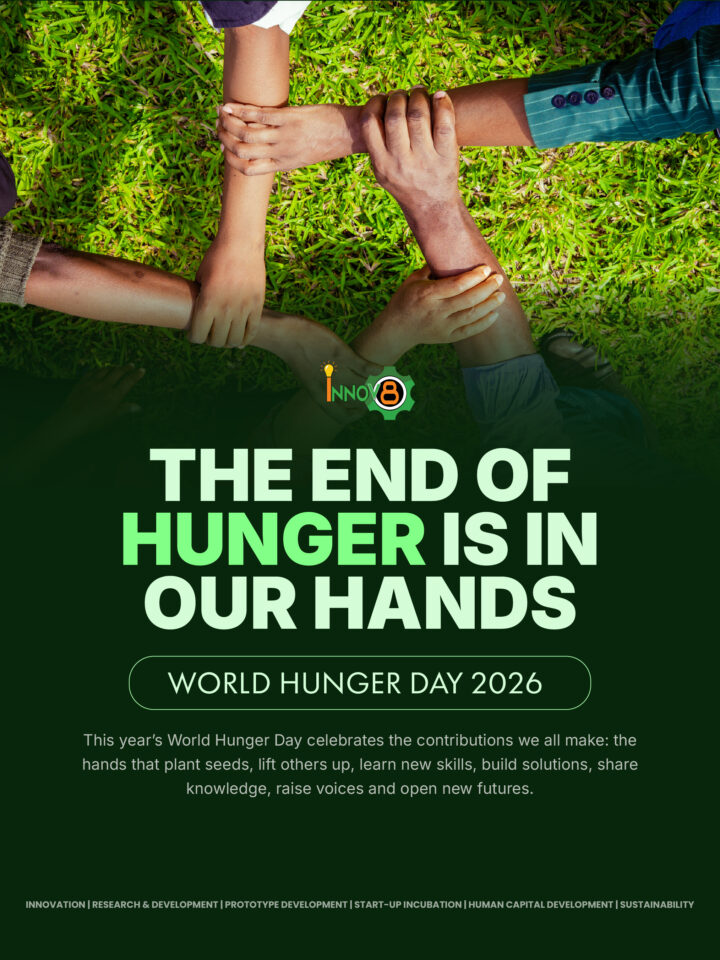
The growing concerns over food insecurity led to the creation of World Hunger Day in 2011, to raise global awareness and to encourage sustainable solutions that address the root causes of food insecurity globally. This year, the theme is “The End of Hunger is in Our Hands” to celebrate the people around the world who are working towards food security.
According to the United Nations, more than 700 million people globally continue to face hunger, while Africa remains disproportionately affected by food insecurity, inflation, and agricultural vulnerability. Nigeria, despite possessing vast agricultural potential, continues to face significant challenges in food production and distribution. Rising food prices, insecurity in farming regions, flooding, post-harvest losses, and limited access to modern agricultural systems have all contributed to increasing pressure on households across the country.
But amid these challenges, efforts are underway to reshape how food is produced, managed, and sustained in the country. At Innov8 Hub, we believe the future of food security will not be solved by agriculture alone. It will be solved through a combination of agriculture, biotechnology, research, sustainability, and innovation-driven systems.
That belief continues to shape the work being carried out through our agritech and biotech departments, particularly through the development of our circular farming system, a model designed to demonstrate how integrated, sustainable agricultural ecosystems can improve productivity, reduce waste, and strengthen long-term food resilience in Nigeria and Africa as a whole.
Beyond Farming: Rethinking Food Systems
For decades, conversations around hunger in Nigeria have often focused narrowly on increasing food production. While production remains important, experts increasingly agree that food security is a systems problem, not simply a farming problem.
The issue is not only whether food is grown, but whether agricultural systems are sustainable, efficient, climate-resilient, and economically viable for the people operating within them.
Globally, agriculture accounts for roughly 70 percent of freshwater use, while food waste and inefficient supply chains continue to undermine production gains. At the same time, climate-related disruptions are making traditional farming cycles increasingly unpredictable.
In Nigeria, smallholder farmers, who make up a significant portion of the agricultural workforce, often face limited access to financing, technology, storage infrastructure, and modern farming tools. Many continue to rely heavily on manual processes and traditional methods despite changing environmental and economic conditions.
This is where innovative thinking becomes essential. Around the world, agritech and biotech solutions are already helping farmers improve productivity and yield through precision agriculture, greenhouse systems, AI-driven monitoring, improved seed engineering, sustainable feed alternatives, and smarter resource management.
Countries investing in agricultural innovation are increasingly positioning food technology as both an economic priority and a national security issue. This shift is also beginning to happen in Nigeria as well.
Innov8 Hub’s Circular Farming Approach
At Innov8 Hub, one of the most important lessons shaping our approach to food innovation is simple: sustainability works best when systems are connected.
Rather than treating poultry farming, aquaculture, greenhouse cultivation, and traditional crop farming as isolated operations, our circular farming system is designed around integration and resource optimization.
The model combines poultry, fish farming, greenhouse cultivation, and regular farming systems in a way that allows different components of the ecosystem to support one another.
With the circular agricultural system, waste from one process can become input for another. For example, organic waste from the Hub’s poultry is used as a nutrient that supports our crops in the greenhouse and orchard. Likewise, the wastewater from the fish farm is recycled through an in-built drip irrigation system and integrated back into the farm as nutrients for the plants, helping reduce waste while maximizing efficiency.
The greenhouse is also designed to improve climate resilience by creating more controlled growing conditions for crops, reducing dependence on unpredictable weather patterns, and improving production consistency. In addition, the entire farming system is powered by solar energy, helping reduce the Hub’s reliance on fossil fuels, lower its carbon footprint, and support a more sustainable closed-loop agricultural system.
This closed farming system matters because the future of agriculture will depend less on isolated productivity and more on sustainable ecosystem design.
Why Agritech Matters More Than Ever
Across Africa, agritech is rapidly evolving from a niche sector into a critical pillar of economic development and food resilience, read our blog on three startup sectors quietly blooming in Nigeria here.
Startups across Nigeria and the continent are developing technologies that connect farmers to digital marketplaces, improve access to financing, optimize supply chains, and reduce post-harvest losses. Precision farming tools, climate monitoring systems, and mobile agricultural platforms are helping bridge information gaps that have historically limited productivity.
But while technology is important, innovation in agriculture cannot succeed through software alone. The most impactful agricultural systems are often the ones that combine technology with a practical understanding of local farming realities. Farmers need solutions that are accessible, adaptable, and economically sustainable within the communities they serve.
This is why Innov8 Hub’s broader innovation strategy focuses not only on infrastructure and experimentation but also on practical application, research collaboration, and ecosystem development. Through several of our innovation and venture development programmes, Innov8 Hub continues to work closely with academia to encourage more research-driven solutions with practical, real-world impact. Rather than allowing valuable research to remain confined to journals or laboratories, the Hub actively promotes a culture of commercialization, experimentation, and problem-solving across sectors including agriculture, biotechnology, and sustainability.
Programmes such as TETFAIR, implemented in collaboration with the Tertiary Education Trust Fund (TETFund), are helping researchers, academics, and innovators rethink how ideas can evolve into viable products, scalable ventures, and sustainable solutions capable of addressing national challenges like food insecurity.
At the same time, the Hub understands that building long-term agricultural resilience also requires investing in younger generations. Through initiatives like the Young Innovators Bootcamp, the Hub introduces children and young people to innovation, science, technology, and practical agricultural thinking at an early stage.
The programme is designed not only to expose participants to emerging technologies such as robotics, AI, and biotechnology, but also to help young innovators understand the growing importance of sustainable farming systems, food production, and climate-conscious innovation. In many ways, it reflects a broader belief that the future of agriculture will belong to a generation capable of combining technology, creativity, and sustainability thinking.
By connecting research, innovation, and youth development, Innov8 Hub is helping build a stronger pipeline of future problem-solvers who can contribute meaningfully to Nigeria’s evolving agricultural and food systems.
The Growing Role of Biotechnology
Food security conversations increasingly include another critical area: biotechnology. As populations grow and climate pressures intensify, biotechnology is playing a larger role in helping agricultural systems become more resilient and efficient. Across the world, biotech research is contributing to crop improvement, disease resistance, sustainable feed production, and environmental management.
At Innov8 Hub, our biotech initiatives are rooted in the understanding that science and innovation must work hand in hand to address long-term sustainability challenges.
Biotechnology offers opportunities not only to improve agricultural output but also to strengthen food systems against future disruptions. Whether through research-driven farming techniques, improved biological processes, or sustainable production methods, biotech is becoming central to the future of modern agriculture.
Yet conversations around biotechnology often require balance and transparency. Public skepticism, regulatory concerns, and ethical debates continue to shape how biotech solutions are adopted globally. Innovation in this space must therefore be approached responsibly, with strong attention to safety, accessibility, and long-term impact.
Innovation and Food Security Are Now Linked
One of the biggest misconceptions about hunger is that it exists only in places where food is scarce.
In reality, modern food insecurity is often connected to systems failure: broken supply chains, inefficient production methods, climate shocks, poor storage infrastructure, rising operational costs and unequal access to resources.
That is why innovation ecosystems have become increasingly important in conversations around sustainability and development.
Innovation hubs, research institutions, startups and policymakers are now playing a larger role in shaping how countries prepare for future food challenges. Around the world, governments and private organizations are investing more heavily in sustainable agriculture, climate-smart farming, and food technology research.
Nigeria’s innovation ecosystem still has significant room for growth, but there is meaningful progress across the ecosystem: Young founders are entering agritech. Universities are becoming more engaged in commercialization conversations, and Sustainability-focused innovation is gaining more attention from investors and development organizations, but more can be done.
Building the Future Responsibly
At Innov8 Hub, we understand that no single organization can solve food insecurity alone. The challenge is too large, too interconnected, and too deeply tied to broader economic and environmental realities.
However, it takes millions of raindrops to form a storm, and in the same way, the collective efforts being made across the world show that this challenge can be solved.
This is the quiet but powerful shift World Hunger Day 2026 draws our attention to. The end of hunger is, quite literally, in our hands, achievable through collective action, not a distant goal to be endlessly pursued.
At Innov8 Hub, we are playing our part in investing in the people, ideas, and systems that turn possibility into production and innovation into impact.
World Hunger Day 2026 is ultimately a reminder that change does not begin with institutions alone, but with individuals, communities, and ecosystems willing to act. Because the truth remains simple: hunger is not permanent. And its end will not come from a single solution, but from many hands working together, planting, building, learning, innovating, and refusing to accept a lifetime of scarcity.